
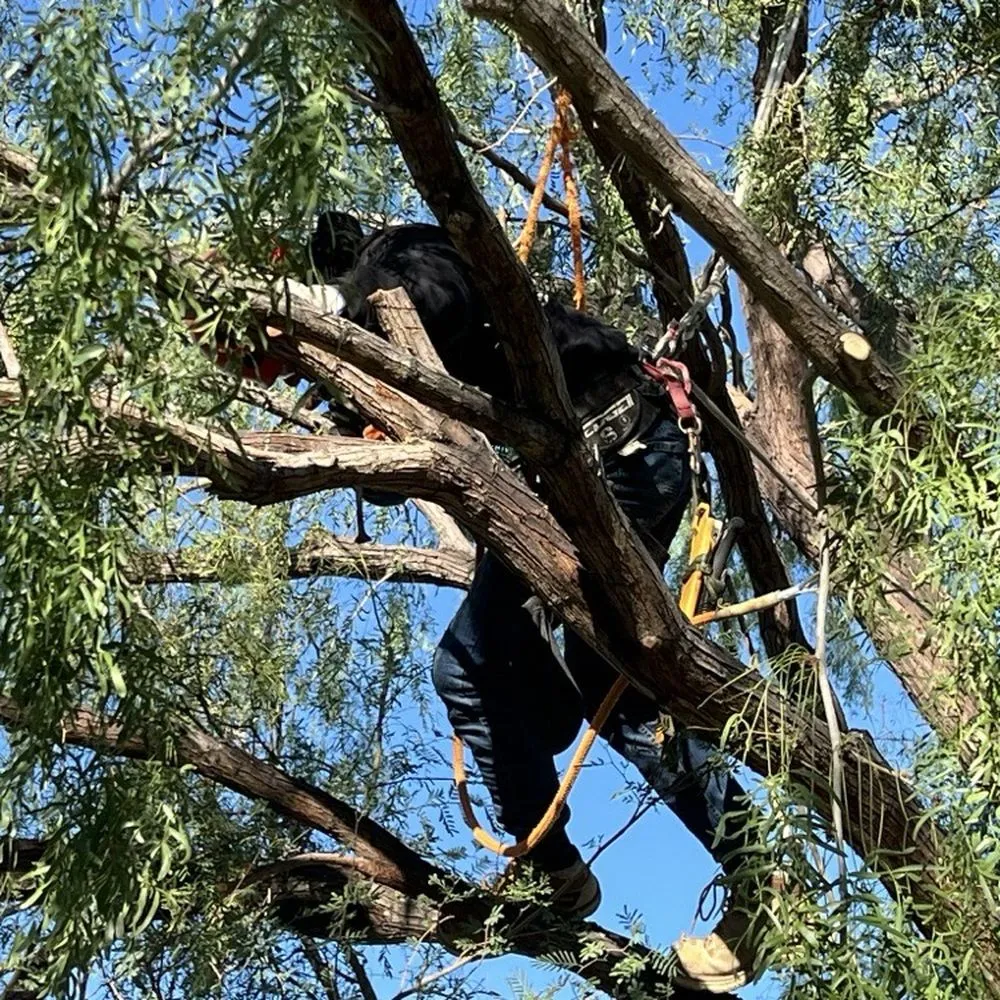
Tree removal vs tree pruning is not simply a choice between “take it down” and “make it smaller.” The better option depends on tree condition, the reason for the work, targets around the tree, access, and whether a retained canopy can realistically meet the property objective.
Start with the property objective
Begin by stating what is wrong from the property owner’s point of view. Is a limb over the roof? Is the tree declining? Has a storm created a crack? Is the canopy blocking vehicle or pedestrian clearance? Is construction changing the root zone? A clear objective prevents unnecessary removal and also prevents pruning from being used as a temporary cosmetic fix when the underlying problem is structural.
Photos are helpful, but the whole tree matters. A close-up of one cavity does not show lean, crown balance, root flare, surrounding targets, or usable rigging space. The decision improves when condition and site context are reviewed together.
When pruning is the better fit
Pruning is often appropriate when the tree is worth retaining and the concern can be addressed with selective cuts. Common objectives include deadwood removal, structural pruning, clearance, correcting rubbing or poorly oriented branches, reducing selected end weight, or managing a storm-damaged limb while keeping the rest of the tree.
The amount and location of live canopy removed matter. Good tree trimming is not measured by how bare the tree looks afterward. It is measured by whether the cuts addressed the stated objective while retaining useful canopy and branch structure.
Educational video: tree pruning essentials
Purdue Extension Forestry and Natural Resources provides a practical overview of pruning fundamentals and why cut selection matters.
When removal deserves serious consideration
Removal becomes more reasonable when a tree is dead, severely declining, structurally compromised beyond a practical mitigation plan, repeatedly failing, incompatible with a major site change, or positioned so the remaining risk cannot be reduced to an acceptable level through pruning or target management.
Removal planning still involves choices. An open-site tree may allow directional felling. A tree over a home, parking area, fence, or landscape may require sectional dismantling and controlled lowering. The tree removal estimate should state how debris, logs, and stump follow-up are handled instead of treating “remove tree” as the entire scope.
Defects only matter in context
A crack, cavity, dead limb, included union, root injury, or lean can be important, but no single defect should be interpreted without the rest of the tree and the target area. A dead limb over a regularly used entrance has a different consequence than similar material over an unused portion of a large lot. A new lean with lifted soil is different from a long-standing phototropic lean with no sign of recent movement.
When the question is genuinely about risk rather than routine maintenance, a focused tree risk assessment can help separate observations, targets, and possible mitigation options.
How access changes the decision
Access rarely determines whether a tree is healthy, but it strongly affects how either pruning or removal is carried out. Narrow gates, rooflines, slopes, overhead lines, neighboring property, parking, fragile landscaping, and limited equipment setup can make a seemingly small job labor-intensive. Conversely, a clear equipment lane and controlled drop zone can simplify work on a much larger tree.
For commercial sites, the work zone may also need to preserve entrances, parking, deliveries, or tenant circulation. Planning those constraints before scheduling reduces surprises for both the crew and the property owner.
Questions to answer before the estimate
- What specific result do you need from the tree?
- What changed recently, if anything?
- What could a branch or tree strike if it fails?
- Is the tree being retained for shade, screening, appearance, or another reason?
- What access is available for climbing, lifts, chippers, grinders, or cranes?
- Should brush, logs, chips, or stump grindings be removed or retained?
A good recommendation explains the tradeoff. Pruning should have a defined benefit, and removal should have a clear reason. If the condition is uncertain, the estimate process should leave room for inspection rather than forcing a decision from a single photo.